He carries the Cross
Fourth Sorrowful Mystery
The Carrying of the Cross
He Bore the Wood of His Own Sacrifice
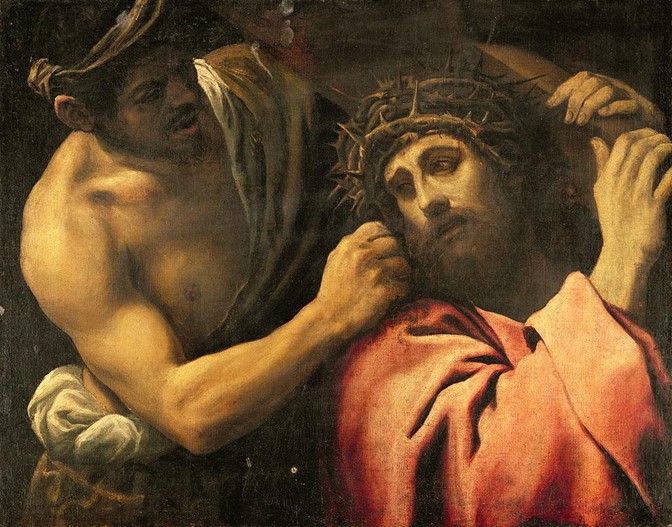
He carried the Cross. Taking upon His own shoulders the means of His sacrificial offering, He bore it from the court of Pilate to a place called Calvary, which in Hebrew is Golgotha (John 19:17). The cross Jesus carried would not only have been large, long enough to be set into the ground and bear His weight, but heavy, a crushing burden for a man already suffering severe blood loss and the effects of the crown. This is why St. Simon of Cyrene was pressed into service to help Him carry it to Calvary.
The full cross would have stood roughly twelve to sixteen feet tall, with a crossbeam of about six feet. These figures come from the French architect and archaeologist Charles Rohault de Fleury in the 1870s, who catalogued the surviving relics of the True Cross preserved by the Church since apostolic times, estimated the wood's volume, and worked back to the cross's likely dimensions. You can read his study of the Instruments de la Passion; the section on the relics of the True Cross begins in Chapter 1 at page 44. (If your French is good; my Latin, Spanish, and Italian only get me so far.)
The average height of men in the Levant in the AD 30s, based on skeletal remains, was around 170 cm, roughly 5 feet 7 inches. (AD, by the way, is Anno Domini, "in the year of the Lord," not "after death," as is often supposed; that would leave the thirty-odd years of His life uncounted.) So picture a man of about 5'7" carrying a cross two to three times his own length and, by some estimates, near 300 pounds, more than a mile up a hill. A healthy man would struggle; the wounded, bloodied, and tortured Christ, His blood perhaps carrying the possible toxins we considered at the Crowning, all the more.
As we pray the Stations of the Cross, we meditate on Christ falling three times on the way to Golgotha (Stations 3, 7, and 9). Knowing His physical condition and the weight of the wood helps us understand, humanly, why He fell. But we must also look to the spiritual reality of His Passion.
His human nature was pushed past its limits by the tortures; that is why He staggered and fell. Yet in the same steps His divine nature was bearing the sins of the whole world to Golgotha. Being God, He could have ended His Passion at any moment, or never begun it. He did not.
Each time He fell, He rose and walked on, not because His body could, but because His love would. The falls are not failures; they are the very shape of a patience that refuses to set the burden down.
He patiently bore the scourging, the blasphemies hurled at Him, and the emotional pain of abandonment by His friends and Apostles. The fruit of this mystery is patience. As we pray and meditate on it, we consider how needful patience is in our own lives when we suffer. We suffer with Christ, and we bear our sufferings patiently, as the will of God asks of us, one step, and if need be one fall and rising, at a time.
Pray each verse, then the Ave Maria, letting the road to Calvary carry the decade. (Scripture here follows the RSV-2CE.)
Comments
Post a Comment